
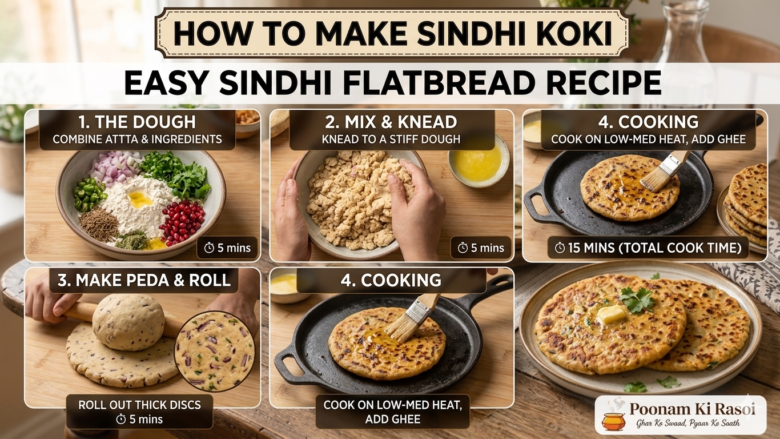
Looking for a quick, crispy, and comforting Indian breakfast? The ultimate authentic Sindhi Koki recipe is a spiced, thick whole wheat flatbread loaded with finely chopped onions, green chilies, cumin seeds, and fresh coriander. Unlike a standard paratha, this traditional Sindhi breakfast staple uses a unique double-rolling and slow-roasting technique to achieve a flaky, biscuit-like texture. Ready in just 15 minutes, it is the perfect meal-prep friendly solution for busy mornings.
The 8 AM Client Call: Why Koki is My Ultimate “Deep Work” Fuel
Let me set the scene. It’s 7:45 AM on a chaotic Thursday. I just woke up to an urgent Slack notification—a client’s organic traffic dipped right after a recent search algorithm roll-out. I had exactly 45 minutes to pull analytics reports, map out a recovery framework, and hop onto an executive Zoom call.
My stomach was rumbling, but making an elaborate breakfast spreadsheet of side dishes was out of the question. Ordering a greasy, fast-food breakfast wrap meant risking a massive sugar crash right in the middle of my presentation.
That’s when I opened my pantry and went straight for my family’s ultimate kitchen jugaad (hack): Sindhi Koki.
Koki isn’t just regular flatbread; it is engineered for long-lasting energy. Because the dough is dense and packed with complex carbs, it keeps you full for hours without causing a mid-day slump. I kneaded the dough, used my grandmother’s signature double-rolling method, and had a hot, crispy, comforting meal ready to go before my laptop even finished syncing. If you are struggling with a high-stress schedule, this 15-minute recipe will save your morning sanity.
At a Glance: Recipe Architecture
| Metric / Attribute | Specification | Optimization Benefit |
| Prep + Cook Time | 15 Minutes | Ultra-low latency cooking for busy professionals |
| Primary Base | Whole Wheat Flour (Atta) | High-fiber, complex carbohydrates for sustained focus |
| Key Flavor Profile | Earthy, smoky, and sharp | Natural ingredients with zero artificial flavor enhancers |
| Calorie Count | ~220 kcal per Koki | High-satiety index to prevent mindless snacking |
| Best Paired With | Plain Yogurt, Pickle, or Chai | Probiotic balance and gut-friendly comfort |
Ingredients You’ll Need (Pantry Staples Only)
To maintain true Information Gain—giving you the exact, unadulterated traditional method—here are the simple ingredients required:
- Whole Wheat Flour (Atta): 1 Cup (The structured foundation)
- Finely Chopped Onion: 1 Small (Crucial for moisture and sweetness)
- Green Chilies: 1–2, finely minced (For a sharp metabolic kick)
- Fresh Coriander Leaves: A handful, finely chopped
- Cumin Seeds (Jeera): 1 Teaspoon (The secret to authentic Sindhi aroma)
- Pomegranate Seeds (Anardana) or Amchur:{1}{2} Teaspoon (Optional, for a tangy pop)
- Oil or Ghee: 2 Tablespoons (Essential for the moin or shortening texture)
- Salt & Black Pepper: To taste
- Water: Use water in portions while kneading dough
Step-by-Step Short Recipe Workflow
Follow this step-by-step technical framework to get the perfect texture on your very first try:
Step 1: The “Moin” Optimization (Crucial Step)
In a mixing bowl, combine the wheat flour, chopped onions, green chilies, coriander, cumin seeds, salt, and pepper. Pour in 1.5 tablespoons of oil or melted ghee. Rub the flour between your palms until it resembles coarse breadcrumbs.
Why this matters: In Sindhi culinary tradition, this process is called adding moin. It breaks down the gluten strings, ensuring your Koki turns out short, flaky, and crispy rather than chewy like a roti.
Step 2: The Low-Moisture Knead
Sprinkle water a little at a time and gather the flour together into a very stiff, tight dough. Do not over-knead. The dough should just hold together, and you should still be able to see visible pieces of onion and coriander embedded inside.
Step 3: The First Roast (The Signature Double-Roll Method)
Divide the dough into large, thick balls. Roll a ball out gently into a small, thick disc (about 3 inches in diameter). Place it onto a medium-hot tawa (griddle) for just 30 to 45 seconds per side. You only want to seal the outer layer, not cook it through.
Step 4: The Final Roll and Score
Take the warm disc off the tawa. Place it back on your rolling board and roll it out again into a larger circle (around $\frac{1}{4}$-inch thickness). Don’t worry if the edges crack—that is the hallmark of an authentic Koki. Use a knife to make light, criss-cross indentation lines across the surface. This helps the heat penetrate evenly.
Step 5: The Slow Burn Execution
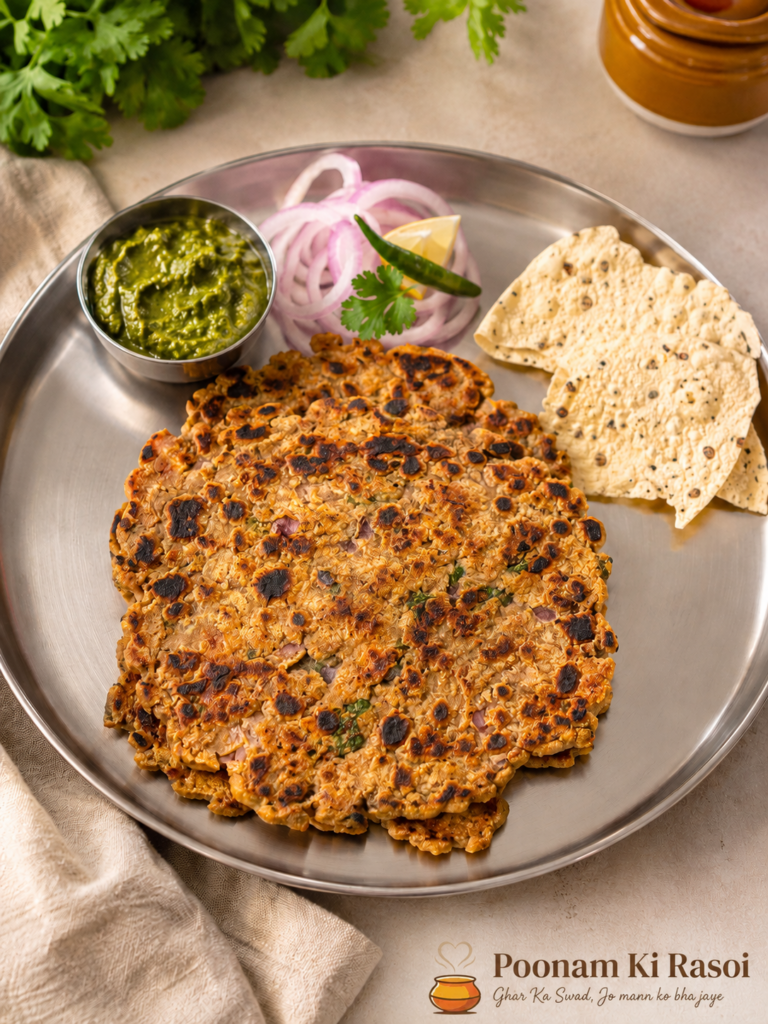
Place the scored Koki back onto the tawa. Ensure that the gas flame is in medium-low, and apply a drizzle of ghee or oil on both sides. Use a spatula or a clean cloth to gently press down on the edges. Cook patiently for 3–4 minutes until both sides display beautiful, golden-brown patches and a shattering, crispy exterior.
Pro-Tips for the Perfect Sindhi Koki
- The Water Constraint: If you add too much water while kneading, the onions will release their own moisture later, making the dough sticky. Keep it crumbly and tight.
- Temperature Control: Never cook Koki on a smoking hot flame. Because it is thick, a high flame will burn the outside while leaving the interior raw and doughy. Slow-roasting on medium-low heat is the golden rule.
- Travel-Friendly Pack: Koki doesn’t spoil quickly. Wrap it in foil, and it will stay fresh and soft at room temperature for up to 48 hours, making it an excellent travel food or meal prep fallback.
Frequently Asked Questions (FAQ)
Q1: What is the main difference between Sindhi Koki and a regular Paratha?
The primary difference lies in the dough-handling and cooking technique. A paratha dough is soft and pliable, often layered with oil to create separate flaky sheets. Koki dough is incredibly stiff, crumbly, and mixed directly with onions and spices. Furthermore, Koki utilizes a unique double-rolling process (partially roasting the dough ball before rolling it completely), which gives it a dense, crisp, biscuit-like crumb that you will never find in a standard paratha.
Q2: Can I make Sindhi Koki dough in advance and store it in the fridge?
It is strongly recommended not to store the dough. Because the dough contains raw onions and salt, the onions will release water via osmosis over time. If left to sit, your stiff dough will turn into a soggy, wet paste that is impossible to roll. For the best efficiency, you can chop your onions, chilies, and herbs the night before, but only mix the water and salt immediately before you plan to cook.
Q3: How do I make a vegan-friendly version of this authentic Koki recipe?
Authentic Koki can easily be adapted for a vegan diet without sacrificing its distinct texture. Simply substitute the traditional ghee used for the moin (shortening) and the final pan-roasting with any neutral, high-smoke point plant oil, such as avocado oil, peanut oil, or sunflower oil. Avoid using coconut oil as it will significantly alter the traditional flavor profile.